
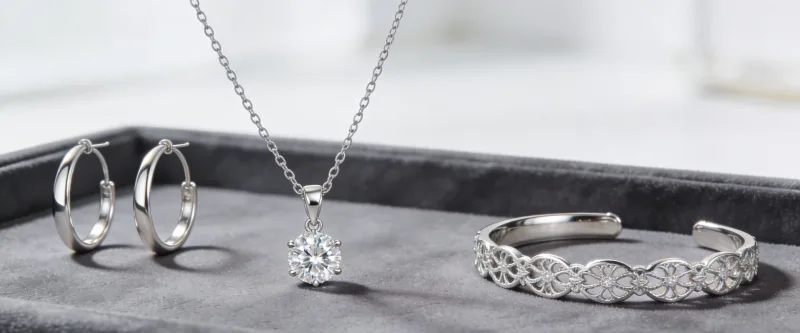
Gold, everyone knows. Silver too. Platinum, on the other hand, remains a mystery for many people. We vaguely know that a platinum record is better than a gold record, we guess that the metal is precious, but few could explain why a platinum piece of jewelry sometimes costs twice as much as its white gold equivalent. The answer lies in three words: rarity, purity, durability. Behind these three qualities lies a unique metal, one that jewelers often refer to as 'the king of precious metals.'
Where does the platinum used in jewelry come from?
When we talk about platinum, we first talk about South Africa. The country alone holds nearly 80% of the known global reserves. Almost everything happens in a single geological area, the Bushveld complex, a rock mass 2.5 billion years old that stretches over 450 km. Russia produces about twenty tons per year, Zimbabwe about fifteen. The rest of the world, almost nothing.
In 2023, global production totaled about 190 tons of platinum. Put this figure against the 3,000 tons of gold extracted each year, and you will understand the price gap. Platinum is roughly thirty times rarer than gold.
But rarity does not explain everything. The extraction itself is an industrial ordeal. To recover 30 small grams of pure platinum, you need to crush and process 10 tons of ore. The purification process takes between five and six months. The mines plunge more than 1,700 meters underground. We are far from the idyllic image of the gold seeker panning a river.
What makes platinum so interesting for jewelry?
Take a platinum piece of jewelry in one hand and a gold piece in the other. The first thing you will notice is the weight. Platinum is between 40 and 60% denser than 18-carat gold. This density gives it an extraordinary solidity and a very particular feel, almost reassuring.
Platinum also has a property that jewelers love: when it is scratched, it does not lose material. Gold does. A gold piece of jewelry that lives on the finger for twenty years ends up slightly thinning. Platinum, on the other hand, moves. The metal shifts under impact instead of wearing away. The result: the ring retains its original weight even after decades. Jewelers speak of 'patina' rather than wear.
In terms of color, platinum is white by nature. There is no need to plate it, rhodium it, or apply a surface treatment. Its natural white never yellows. White gold, on the other hand, cheats a little: its hue comes from an alloy with palladium covered with a layer of rhodium that needs to be redone every two or three years to avoid yellowing. On this point, the match is clear.
One last detail that matters for reactive skin: 950 platinum contains no nickel. Zero. It is a naturally hypoallergenic metal, making it perfect for a piece of jewelry worn every day, especially a wedding band or engagement ring.
Why are diamonds so often set in platinum?
Cartier does it. Van Cleef & Arpels too. Chaumet, Graff, Tiffany... The world's greatest jewelry houses set their most beautiful diamonds in platinum. And there is a technical reason for this.
The neutral white of platinum does not interfere with the color of the stone. A diamond set on yellow gold absorbs golden reflections. On platinum, it remains pure, transparent, true to its actual color. For a diamond of quality D or E (the whitest), the difference is striking. Discerning buyers know this.
The other reason is mechanical. Platinum holds claws better than any other metal. Its natural firmness allows for very fine settings without risking the stone coming loose. A diamond set in platinum is safer than on any other support.
This love story between platinum and diamond goes back a long way. In 1867, at the Paris World Exposition, the Mellerio house showcased a platinum tiara that caused a sensation. The Spanish crown acquired it shortly thereafter. Since that date, platinum has not left the world of high jewelry.
How much does a piece of platinum jewelry cost?
Let's be clear: platinum is expensive. More expensive than gold, and by far when you add manufacturing costs. Working with platinum requires a particular know-how. Its melting point rises to 1,768 °C, almost double that of white gold (about 1,000 °C). The workshops that master this metal are not common.
Specifically, pure platinum jewelry is mainly aimed at high jewelry clientele. Engagement rings with diamonds, high-end wedding bands, prestige sets. There is demand because platinum carries a strong promise: that of a piece of jewelry that withstands the test of time without weakening.
For those who want platinum without breaking the bank, alloys offer an alternative. 850 platinum (85% pure platinum) or 900 platinum cost less than 950 while retaining the essentials: color, durability, hypoallergenic properties. These alloys mix platinum with iridium or ruthenium to enhance its hardness. Visually, it is impossible to tell the difference with the naked eye.
How to know if a piece of platinum jewelry is authentic?
First reflex: check the hallmark. In France, a piece of jewelry containing at least 950 thousandths of platinum bears an official hallmark. Historically, it was a dog's head (established in 1912). The marks have evolved since 1994, but the principle remains the same: no hallmark, no guarantee.
On jewelry purchased abroad, look for the engraving 'Pt 950' or 'Pt 999' inside the ring. The number indicates the proportion of pure platinum. A Pt 950 piece contains 95% platinum. That's much more than 18-carat gold and its 75% pure gold.
Home test for skeptics: bring a magnet close to your jewelry. Platinum does not react to magnetic fields. If the ring sticks to the magnet, it is not platinum.
How to care for your platinum jewelry?
Platinum is perhaps the easiest metal to live with on a daily basis. Soap does nothing to it. Pool chlorine neither. Sea water? Not afraid at all. A gentle brush with warm soapy water is enough to revive it when it loses a bit of shine.
Over the months, the jewelry develops a satin patina. Some people love this slightly aged matte look. Others prefer the shine of the first day. In that case, a trip to the jeweler for polishing resets the counters. Once a year is more than enough.
What makes platinum truly unique is its longevity. A piece of platinum jewelry worn for forty years loses neither weight nor volume. It is passed down from mother to daughter (or father to son) with exactly the same mass as on the day of purchase. Few materials can say the same. This is probably why platinum jewelry so often ends up as family heirlooms, worn by three or four successive generations without ever needing 'repair.'